


The garage door is one of the most-used moving systems in the entire home, yet for many homeowners, it still operates like it’s stuck in a different era—open, close, hope for the best. But the world has changed. Homes are becoming smarter, families are moving faster, and expectations for safety and control are higher than ever.
That’s where microcontrollers quietly enter the conversation.
Microcontrollers don’t just power hobby projects and DIY gadgets. When applied correctly, they can turn a garage door system into a far more intelligent entry point—one that feels smoother, safer, more responsive, and dramatically more reliable. And what makes this especially interesting is that a garage door is the perfect real-world intersection of mechanical engineering, electrical design, and software logic. It’s not just a door. It’s a controlled machine.
Why Microcontrollers Make Sense for Garage Door Systems
A standard garage door system already relies on some electronics—basic sensors, a motor, and a control board. But most setups still function with limited feedback and minimal intelligence. They react instead of thinking. They’re good enough, until they aren’t. Then you get the common headaches: random reversals, loud and uneven movement, false safety triggers, and mysterious “it worked yesterday” failures.
Microcontrollers change the nature of the system because they’re built for decision-making.
In short, it transforms the garage door from a simple mechanical system into an adaptive system.
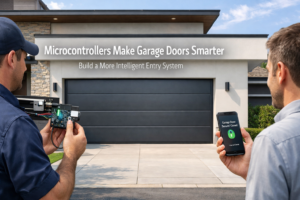
The Real Upgrade Is Awareness
The most powerful feature of an intelligent garage door system isn’t remote control. It’s awareness.
An intelligent entry system knows what’s happening while the door is moving. It can detect things like:
When the door is moving slower than usual
When the motor is drawing more power than it should
When vibration or friction is increasing over time
When the door stops short of its normal fully open position
When safety sensors are misaligned or intermittently failing
These are the early warnings that usually go unnoticed—until a spring snaps, a door gets stuck halfway, or someone calls for emergency repair. Microcontroller-based monitoring helps you catch small issues before they become expensive problems.
That’s not just convenience. That’s prevention.
Smarter Control Makes Homes Safer
Garage doors are heavy. They involve tension, high torque, moving parts, and real momentum. So safety isn’t optional. It’s the foundation.
A microcontroller-driven system can improve safety by supporting smarter logic and more flexible reactions. For example, instead of a basic “stop and reverse” response, a smarter controller can reduce motor speed when it detects resistance, or it can pause and re-check sensor data before deciding what to do next.
It can also add redundancy. Traditional garage doors rely heavily on photo-eyes and limit switches. If one component fails or becomes unreliable, the whole system can behave unpredictably. With microcontroller-based intelligence, you can combine multiple sensor readings and build a more trustworthy decision process.
That means fewer false reversals, fewer unexpected stops, and less risk of the door closing when it shouldn’t.
What This Means for Security
Home security isn’t only about locks. It’s about control and visibility.
A garage door is one of the most common entry points for break-ins, partly because many systems don’t provide homeowners with enough feedback. People leave home and assume the door is closed. They go to sleep and assume it stayed closed. But assumptions are not security.
An intelligent system can confirm status with confidence, track activity, and trigger alerts when something feels wrong. It can detect repeated open attempts, unexpected movement, or unauthorized control signals. It can even give homeowners logs that show when the door opened, for how long it stayed open, and when it closed again.
The result is simple: the garage door becomes a monitored entry system, not a blind spot.
Reliability Comes From Better Data
If you’ve ever dealt with garage door issues, you already know this truth: most failures are not sudden. They’re progressive. They start as small friction, slight misalignment, or a motor that’s working harder than normal.
The problem is that standard systems don’t speak in a language homeowners can understand. They don’t warn you. They just fail.
Microcontrollers unlock the ability to translate mechanical stress into useful information. The system can track patterns over weeks or months and identify behavior changes long before the failure happens.
And that’s where the “intelligent entry system” becomes more than a feature. It becomes a maintenance advantage. The garage door isn’t just opening and closing—it’s becoming measurable.
The Best Smart Garage Systems Still Respect the Mechanics
One of the biggest misconceptions about smart upgrades is thinking intelligence can replace proper mechanical setup. It can’t.
A garage door still needs correct spring tension, balanced movement, solid rollers, aligned tracks, and healthy hardware. No amount of automation can fix a door that’s physically fighting itself. If anything, intelligence becomes more valuable when the mechanics are correct, because it amplifies smoothness instead of compensating for damage.
A truly upgraded system is one where the mechanics are strong, the wiring is clean, and the control logic is smart enough to keep everything operating within safe limits.
Why This Matters for Homeowners Right Now
We’re entering an era where homeowners expect their homes to behave like modern systems—responsive, measurable, and secure. Smart thermostats have already set that expectation. Doorbell cameras have normalized it. Garage doors are next.
Because when you think about it, the garage door is the one moving system that your family depends on every day. It protects vehicles, tools, storage, and sometimes direct access into the home. It’s not just another smart gadget. It’s a high-impact upgrade point.
Adding intelligence through microcontrollers is about building a garage door system that fits today’s lifestyle: safer movement, better monitoring, and fewer surprises.
The Future of Garage Door Service Will Be Smarter
The most advanced garage door repair South Pasadena technicians are already shifting toward diagnostics, sensor-based troubleshooting, and higher-level system checks—not just “replace the part and hope.” As intelligent controllers become more common, the service industry will follow.
And homeowners will win, because the best kind of repair is the one you never need.
A microcontroller-powered garage door system isn’t about being flashy. It’s about the same thing good engineering has always aimed for: reliability, clarity, and control. The garage door becomes less of a mechanical gamble and more of a predictable machine—exactly the way it should be.